

French Company Revives Disused Railway Tracks
France currently has approximately 5,700 kilometers of small-scale railway tracks that are no longer in use. The high cost of upgrading these tracks to accommodate modern, heavy trains has led to the near-total disappearance of public transport in many rural areas.
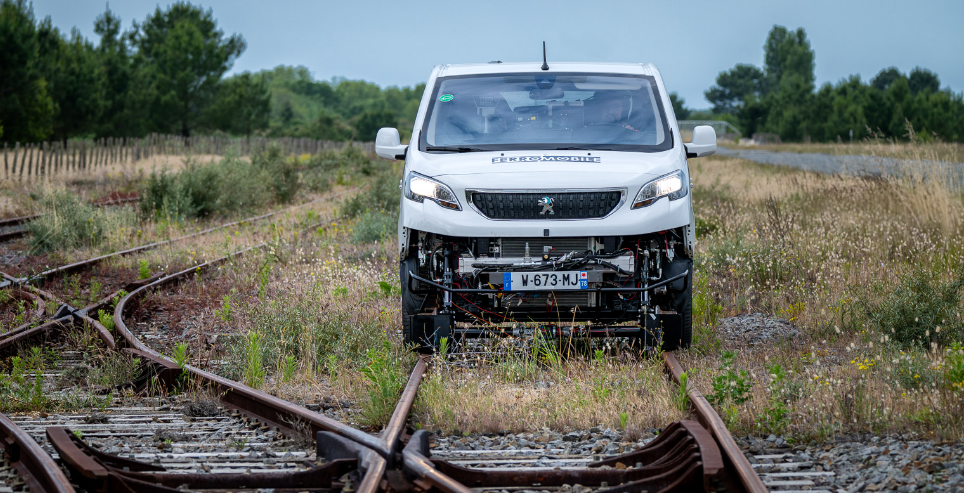
However, a French initiative has developed an alternative solution to reactivate this idle infrastructure. SICEF, an engineering company and a member of AKKA Technologies’ Flexmove consortium, aims to bring these tracks back into operation using rail-adapted hybrid minibuses instead of conventional trains. These vehicles, known as Ferromobiles, are expected to strengthen environmentally friendly transport connections in rural regions that are heavily dependent on private cars.
According to SICEF, the 5,700 kilometers of unused railway tracks across France have left vast rural areas without access to public transportation. The company’s solution involves deploying vehicles adapted from the Peugeot e‑Traveller, capable of traveling both on roads and on railway tracks. Thanks to an integrated technical system, the minibuses can transition seamlessly between road and rail.
As of February, SICEF has begun testing Ferromobiles on the Courpière–Vertolaye track in the Auvergne region. If the trials prove successful, the project is expected to be expanded to other regions such as Occitanie, Brittany, and Nouvelle‑Aquitaine.
A Low-Carbon Mobility Model for Rural Areas
With a passenger capacity of up to eight people, Ferromobiles can be operated in two different modes. They may run on scheduled services with short waiting times, or function as a fully demand-responsive service available 24/7 through a mobile application. The company describes this concept as “Uber on rails.”
Passengers will be collected from specially established stops along the railway track. While operating on the tracks, the vehicles will function in automatic mode, and once they switch to road travel, control will be handed over to the driver. From a safety perspective, it is emphasized that the railway tracks used by Ferromobiles will not be shared with conventional trains.
The project aims to provide a low‑carbon transport alternative for rural areas by reusing existing railway infrastructure and relying exclusively on fully electric vehicles. This approach is intended to avoid costly infrastructure investments while offering more environmentally friendly mobility solutions in regions that currently rely heavily on private cars.
Source: Euronews


 Popular News
.png)