

The Middle Corridor on the Rise as a New Trade Route
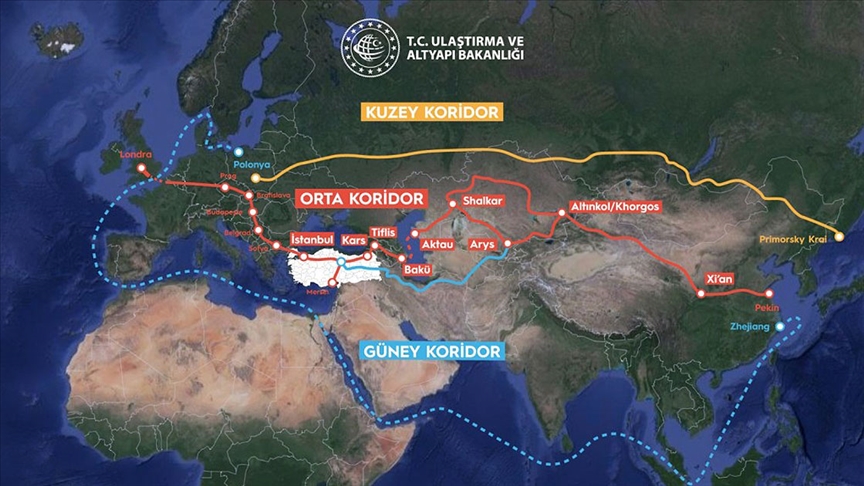
Geopolitical disruptions across global trade routes are rapidly increasing the importance of alternative logistics networks, with the Middle Corridor (Trans-Caspian International Transport Route – TITR) emerging as one of the most strategic routes of the new era. Positioned at the heart of this corridor, Türkiye and Azerbaijan are playing a central role in the restructuring of global supply chains.
Recent risks have placed significant pressure on traditional trade routes. Tensions in the Strait of Hormuz, growing security threats in the Red Sea, and restrictions on the Northern Corridor via Russia due to sanctions have pushed global transportation toward alternative routes. These developments have made the Middle Corridor a more reliable and predictable option for trade between Asia and Europe.
The Middle Corridor at the Center of the ITF Summit
The 2026 International Transport Forum (ITF) held in Leipzig, Germany, stood out as one of the clearest reflections of this shift. With more than 1,200 participants from over 80 countries, the Middle Corridor was brought to the forefront of the global agenda in an unprecedented way.
Azerbaijan’s presidency of the forum further increased its visibility in this process, while discussions during the summit highlighted that supply chain resilience depends not only on infrastructure but also on financing and long-term strategic planning.
The most critical issue for the future of the Middle Corridor was identified as financing. Limited investment capacity in some countries along the corridor poses a significant risk to sustainable growth.
Infrastructure and Integration Investments Deliver Results
Azerbaijan’s recent infrastructure investments have been among the most important factors strengthening the operational capacity of the Middle Corridor.
The Port of Alat, located south of Baku and operational since 2018, has emerged as a key logistics hub integrating maritime, rail, and road transport.
Following its integration with Azerbaijan Railways in 2025:
- seamless intermodal transitions have been enabled
- operational efficiency has improved
- digital logistics infrastructure has been strengthened
This structure significantly reduces bottlenecks along the corridor.
Türkiye’s Role and the BTK Railway
One of the most critical components of the Middle Corridor, the Baku–Tbilisi–Kars (BTK) railway, is reinforcing Türkiye’s strategic position in the system.
Thanks to this 846-kilometer railway line:
- transit time from China to Europe has been reduced from 45–50 days to 15–19 days
- annual transport capacity has reached 5 million tonnes
- capacity is expected to increase to 8–10 million tonnes
These developments show that Türkiye is not only a transit country but also a central actor in the global logistics network.
Rapid Growth in Cargo Volumes
Cargo volumes along the Middle Corridor have increased significantly in recent years:
- 2021: 840,000 tonnes
- 2024: 4.5 million tonnes
- 2025 (forecast): 5.2 million tonnes
Approximately 63% of total cargo passes through Azerbaijan, highlighting the country’s strategic role within the corridor. By 2027, total volume is expected to exceed 10 million tonnes.
Container transport has grown even more dramatically. Shipments between China and Europe via Azerbaijan have increased 28-fold since 2019.
New Routes and Multimodal Integration
The launch of the Beijing–Baku rail-sea-rail route in 2025 has significantly strengthened the corridor’s intermodal capability.
With this system:
- door-to-door delivery time has dropped to as little as 15 days
- rail and maritime integration has been enhanced
These developments demonstrate that the Middle Corridor is no longer just an alternative but is becoming a competitive primary trade route.
Türkiye Elected to ITF Presidency
A major development for Türkiye also took place during the summit. Türkiye was elected to the ITF Presidency for the 2027–2028 term.
Turkey’s Minister of Transport and Infrastructure, Abdulkadir Uraloğlu, emphasized that Türkiye is not merely a transit country but a strategic hub connecting Europe, Asia, and the Middle East. It was also highlighted that projects such as the Middle Corridor and the Development Road initiative will further strengthen Türkiye’s role in global trade.
Changing Geopolitical and Logistics Dynamics
Global trade is no longer shaped solely by cost and speed but increasingly by security, continuity, and geopolitical risks. In this new environment, the Middle Corridor stands out as:
- a reliable alternative route
- a network free from conflict zones and maritime risks
- a highly integrated logistics system
Azerbaijan’s balanced foreign policy and Türkiye’s strong infrastructure investments are making the corridor more competitive within the global trade system.
Source: UAB


 Popular News
.png)