
Giant Tunnel Built with Artificial Islands in Hong Kong
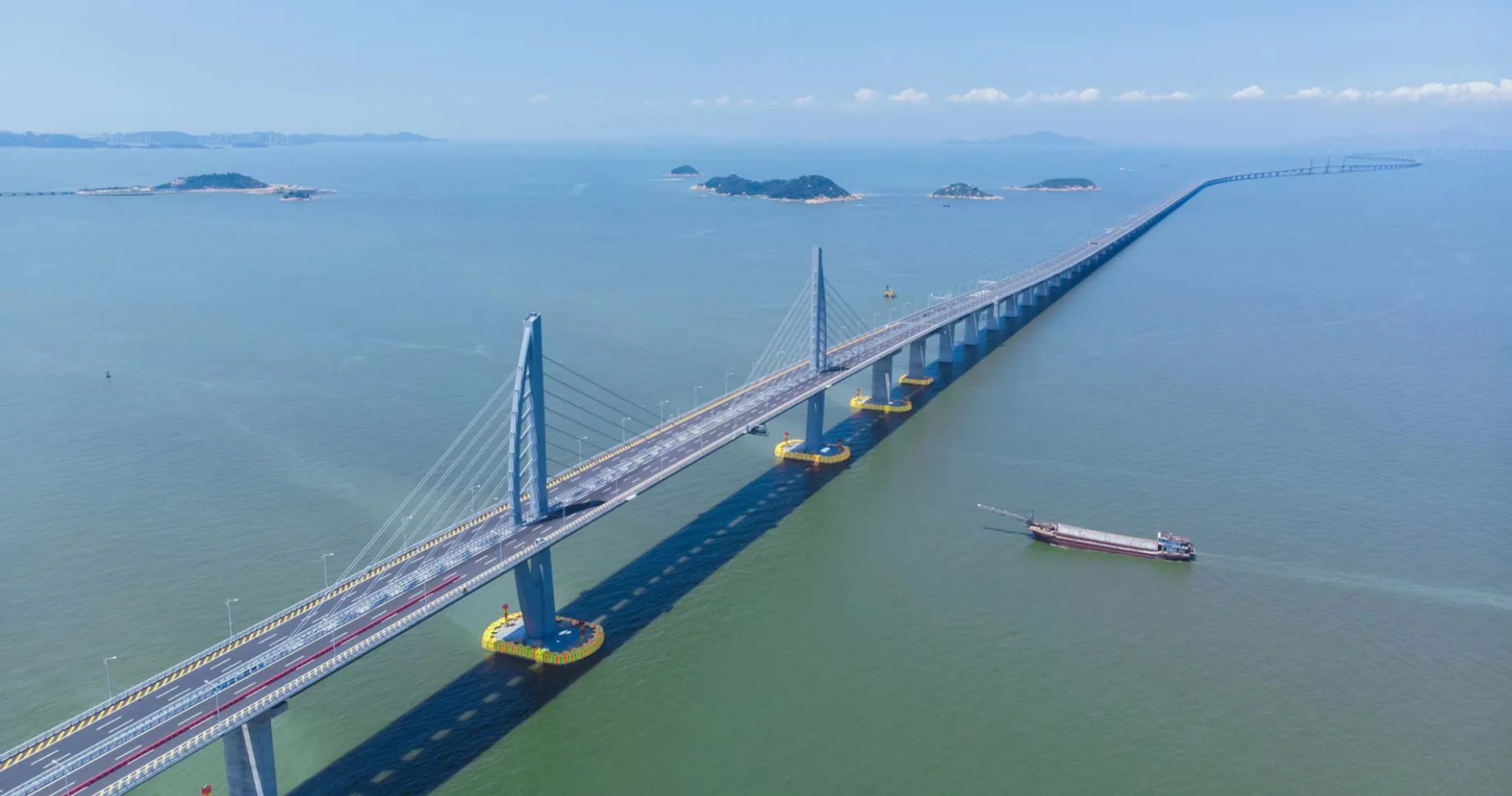
The Hong Kong–Zhuhai–Macau Bridge (HZMB), one of the world’s largest transportation and infrastructure projects, stands out not only for its engineering achievement but also for its impact on regional trade and logistics. Opened in 2018, the project has become one of the key logistics backbones of China’s Greater Bay Area strategy today.
The approximately 55-kilometer bridge–tunnel system connects Hong Kong, Zhuhai, and Macau, reducing journeys that previously took hours by road to around 40–45 minutes. This transformation directly impacts not only passenger transportation, but also freight operations, airport connectivity, tourism, and cross-border trade activities.
One of the World’s Longest Bridge–Tunnel Sea Crossings
According to official Hong Kong government project data, the HZMB system consists of:
- an approximately 29-kilometer main bridge
- an approximately 6.7-kilometer underwater tunnel
- Hong Kong and Zhuhai link roads
- artificial islands and border crossing facilities
developed as an integrated mega transportation network.
The structure is not simply a bridge stretching across open waters; it was designed as a multilayered logistics corridor combining bridges, underwater passages, and artificial island infrastructure.
Artificial Islands Became the Project’s Most Critical Component
One of the most remarkable engineering solutions of the project was the construction of two massive artificial islands built entirely from scratch in the middle of the sea.
These artificial islands serve as:
- entry and exit points for the underwater tunnel
- maintenance and service zones
- technical operation centers
The islands enabled uninterrupted integration between the bridge system and the underwater tunnel. At the same time, they provided a crucial engineering solution to prevent disruption to the region’s intense maritime traffic.
Experts consider the project one of the world’s most advanced examples of marine engineering and infrastructure planning.
A Massive Tunnel 55 Meters Below Sea Level
One of the most impressive sections of the HZMB is its approximately 6.7-kilometer underwater tunnel system. The tunnel was positioned roughly 55 meters below sea level.
This decision was made specifically to avoid interrupting heavy shipping traffic in the Pearl River Delta, one of China’s busiest logistics and port regions. As a result, large container vessels can continue navigating through the area without obstruction.
The project utilized immersed tube tunnel technology. Massive prefabricated concrete segments were precisely installed onto the seabed and connected together.
The tunnel system was also engineered to withstand:
- typhoons
- severe marine conditions
- earthquake risks
- immense water pressure
The Logistics Backbone of the Greater Bay Area
The Chinese government positions the project not merely as a transportation investment, but as a core part of the economic integration strategy for the Guangdong–Hong Kong–Macau Greater Bay Area.
The region is considered one of China’s strongest economic zones in sectors such as:
- manufacturing
- technology
- finance
- logistics
- tourism
One of the bridge’s primary objectives is to shorten distances, accelerate trade, and reduce operational costs.
2026 Data: Bridge Usage Continues to Grow Rapidly
According to figures shared by China’s State Council in 2026, more than 100 million passenger crossings have been recorded through the Zhuhai port since the HZMB opened.
More than 58.7 million of these journeys were reportedly made by Hong Kong and Macau residents.
The approximately 18 million crossings recorded in 2025 alone indicate remarkable growth. This figure represents nearly a 300% increase compared to 2019 levels.
The data shows that the project has evolved beyond being a symbolic engineering achievement and has become an actively used economic and logistics corridor.
A 24/7 Corridor Offering Critical Logistics Advantages
The bridge operates 24 hours a day, providing a major advantage for logistics and supply chain operations.
This enables:
- faster cargo transportation
- stronger airport connectivity
- easier cross-border supply chain management
- optimized business travel
The infrastructure is considered especially critical for e-commerce logistics and fast-delivery operations.
Environmental Considerations Were Also Part of the Design
Environmental impact played a significant role throughout the planning process.
According to technical information shared by engineering company Arup, the project incorporated:
- structural systems designed not to block water flow
- minimized seabed impact
- solutions aimed at protecting the habitat of Chinese white dolphins
For this reason, the HZMB is regarded not only as a major transportation investment, but also as an important example of sustainable infrastructure development.
The Hong Kong–Zhuhai–Macau Bridge demonstrates that modern logistics infrastructure is no longer limited to roads and bridges alone. Supported by artificial islands, underwater tunnels, intelligent transportation systems, and multimodal connectivity, the project offers a powerful example of how future trade corridors may evolve.
Today, the HZMB is considered one of the world’s most strategic mega infrastructure investments in both logistics and engineering.


 Popular News

.png)